
Vector Classic
NEKKIArcade
4.83.56K Reviews
- Version
- 1.5.0
- Installs
- 1.00M
- Age Rating
- Everyone 10+
Screenshots







Our Review of Vector Classic
 Analysis by Appyee
When I’m choosing a phone game for a short break, I want to know more than whether it looks exciting: I want to know how it feels to control, whether it rewards practice, and what kind of player will enjoy its demands. Vector Classic is an arcade game built around a runner’s escape, and its appeal comes from turning jumps, slides, and other parkour moves into a quick test of timing. I’d consider it if I wanted focused action rather than a sprawling game to manage, but its rhythm and challenge are not for everyone.
What to consider before you start
The central decision is whether you enjoy learning a route through repeated attempts. In Vector Classic, a run is not just a matter of holding a direction and watching the character move. You need to read what is coming and react at the right moment, so the satisfaction comes partly from getting a movement to land cleanly after you have misjudged it before. If you find that sort of trial and adjustment rewarding, the format has a clear hook.
If you mainly want an arcade game that lets you switch off and succeed without much attention, this may feel more demanding than its simple controls suggest. A small set of gestures is easy to understand, but that does not mean every obstacle is easy to clear. I’d go in expecting a game that asks for concentration in short bursts, not one that plays itself while you glance at something else.
Why the running feels distinctive
First off, the premise is pretty straightforward but gives the action a reason to keep moving: you’re a lone runner trying to escape the clutches of a totalitarian regime. I like that the chase creates a sense of urgency without requiring a long setup before the running begins. It gives the parkour a dramatic frame, while the moment-to-moment focus stays on making it through the next obstacle.
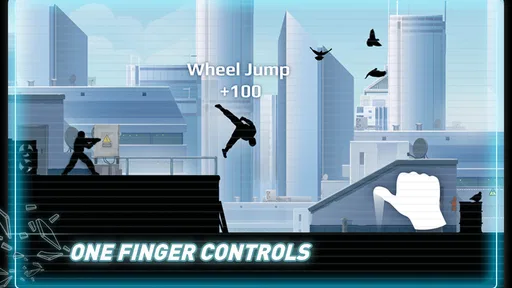
What really hooks you in is the gameplay. The controls are intuitive: swipe up to jump, swipe down to slide, and swipe left or right to accelerate. That low barrier makes it approachable even if you’re not a regular action-game player. The catch is that the gestures still require good timing. When I get a move right, the clean sequence feels earned; when I react late, I can usually see why the attempt went wrong, which makes trying again feel worthwhile rather than random.
How to get more from each attempt
A useful way to approach a difficult section is to treat the first run as a chance to learn its rhythm, not as a demand to clear everything immediately. Notice which movement you tend to mistime and focus on that response on the next try. This is especially helpful when the pressure of the chase makes you swipe too early. I find it more effective to watch the obstacle and respond deliberately than to make a string of hurried gestures.
There’s also a practical trade-off in customizing the runner with new tricks. Unlocking and trying different moves can make progression feel more personal, but it also gives you another reason to pay attention to the options rather than simply rushing through levels. I’d experiment when I have a little time to learn a trick’s place in the run, rather than changing things during a quick session and expecting that choice to solve a timing problem by itself.
The levels bring their own challenges, and the difficulty rises as you advance. That makes progress feel more like learning than simply repeating the same easy sequence. It also means that someone who wants a reliably gentle experience may hit a point where the game asks for more patience than they planned to give. I would treat a failed attempt as useful feedback, but if retries start to feel like a chore, there is no need to force a long session.
Style, sound, and the pace of play
The silhouette-style art is one of the game’s strongest choices. It keeps the runner and the movement easy to read while giving the chase a sharp visual identity. The animations add much of the personality: a jump, roll, or landing feels like part of a continuous performance rather than a sequence of static obstacles. That visual clarity matters in a reflex game, because busy scenery could make it harder to focus on the action.
The soundtrack supplies energy that suits the escape, and I find it helps make a short run feel more dramatic. The trade-off is that the urgent mood may be less appealing if you want something quiet or soothing while you play. If you’re using the game for a calm wind-down, its chase atmosphere might not fit; if you want a burst of momentum during a break, the music and animation work together well.
Where it fits among arcade alternatives
Compared with an endless runner that emphasizes staying alive for as long as possible, Vector Classic’s level-based structure gives me a clearer sense of a particular challenge to learn and finish. Compared with a broad platform game, it keeps attention on the runner’s momentum and timed parkour rather than asking me to explore a larger world. That makes it a good fit when I want a compact action game with a strong visual style, but a weaker fit if I’m looking for open-ended exploration, relaxed puzzle solving, or a session that does not depend on reflexes.
A realistic use case is a few minutes between errands: I can start a level, concentrate on one run, and stop without needing to keep a long story or complex system in mind. On the other hand, I wouldn’t choose it while walking, chatting, or doing anything that divides my attention. Its simple gestures can make it look casual, but responding well still calls for eyes on the screen. That distinction is easy to miss if you judge it only by how quickly the controls can be learned.
It is also worth choosing the right mood for it. When I’m in the mood to improve, the chase gives a failed run a clear next step: try again with better timing. When I’m tired and want a game that is forgiving from the first moment, I’d be better off with a gentler arcade option. The important question is not whether the game is difficult in the abstract, but whether I enjoy that particular loop of observing, reacting, and refining.
Price, device fit, and what to expect
Vector Classic costs $0.99, with in-app purchases priced from $0.99 to $4.99 per item. That gives the initial decision a simple entry price, while the optional purchases are something to keep in mind if you prefer to avoid extra spending after downloading a game. I would decide based on whether the core chase and level progression are the kind of play I want, rather than assuming that spending more is necessary to enjoy a reflex-focused arcade game.
The game is rated Everyone 10+, and NEKKI is the developer. It was released on April 26, 2013, and the current version is 1.5.0, with Android 6.0 as the minimum operating-system requirement. Those details are useful when checking whether it suits your device and household; the age rating is also a reminder to make your own choice about whether its chase premise is right for the player.
Its average rating is 4.8 from around 76 thousand ratings, and it has over one million installs. I’d take that as a sign that the game has found a substantial audience, not as a guarantee that its specific challenge will suit every player. For me, the more useful test is whether I like skill-based retries and the distinctive silhouette presentation. Those are the qualities that determine whether I would keep coming back.
The Thrill of the Chase
First off, the premise of Vector Classic is pretty straightforward but oh-so-addictive. You’re a lone runner trying to escape the clutches of a totalitarian regime. So yeah, it’s like a dystopian version of tag, where the stakes are high, and the only way out is through a series of daring stunts.
What really hooks you in is the gameplay. The controls are super intuitive, which means you don’t need to be a gaming pro to get into the groove. Swipe up to jump, swipe down to slide, and swipe left or right to accelerate. It’s all about timing, and trust me, landing that perfect jump feels ridiculously satisfying.
Visuals That Pop
Let’s talk about the graphics, shall we? The game features a slick, silhouette-style art design that’s both simple and striking. It’s like watching a high-speed chase unfold in a minimalist art gallery. The animations are smooth as butter, making each leap and roll feel as fluid as a real-world parkour stunt. Honestly, it’s one of those games where you almost want to fail just to see the cool animations play out.
Soundtrack to Your Escape
Now, what’s a good chase scene without the right soundtrack? The music in Vector Classic is spot on, offering a pulse-pounding backdrop that perfectly matches the urgency of your escape. It’s the kind of beat that keeps your heart racing and your fingers tapping. It almost feels like the music is egging you on, whispering, "Go on, you can make that jump!"
Levels and Challenges
The game isn’t just about running endlessly. There are multiple levels, each with its own unique challenges and obstacles. As you progress, the difficulty ramps up, keeping you on your toes. There’s a real sense of achievement as you master each level, and that’s what keeps you coming back for more.
There’s also a nifty feature where you can customize your runner with new tricks. It’s a great way to add a personal touch to your gameplay and keep things fresh. Whether you’re flipping over obstacles or sliding under barriers, each move feels like a tiny victory.
Why You Should Try It
If you’re looking for a game that’s easy to pick up but hard to put down, Vector Classic is a solid choice. It’s perfect for those moments when you want a quick thrill or need a break from the daily grind. Plus, it’s always fun to imagine yourself as a parkour master, even if it’s just on your phone.
Overall, Vector Classic offers an exhilarating blend of challenge and fun, wrapped up in a package that’s as stylish as it is engaging. So, if you’re ready to test your reflexes and live out your action hero fantasies, give this game a go. You might find yourself hooked on the chase!
Verdict
Strengths of Vector Classic
- Smooth and intuitive controls.
- Stylish, minimalist graphics.
- Challenging but fair levels.
- Engaging parkour mechanics.
- No intrusive ads.
Limitations of Vector Classic
- Limited storyline depth.
- Repetitive background music.
- In-app purchases required for extras.
- Occasional frame drops.
- No multiplayer mode.
Other Releases by NEKKI
View All
Vector
Arcade4.7

Shadow Fight 3 - RPG fighting
Role Playing4.6

Shadow Fight 2
Action4.6

Shadow Fight 2 Special Edition
Action4.6
Similar Picks in This Category
View All
Subway Surfers
SYBO Games4.6

Stickman Party 234 MiniGames
PlayMax Game Studio4.6

Subway Princess Runner
Ivy4.4

Temple Run
Imangi Studios4.2

Zombie Tsunami
Mobigame SAS4.6

Stack Ball - Crash Platforms
CASUAL AZUR GAMES4.5
Frequently Asked Questions
What is Vector Classic, and what makes it unique?
Vector Classic is a thrilling parkour-inspired action game where you play as a character escaping a totalitarian world. Its uniqueness lies in its simple yet compelling visuals, intuitive controls, and fluid animations that perfectly capture the essence of free-running. The game challenges players with intricate levels that require precision and timing.
Is Vector Classic free to play, or are there in-app purchases?
Vector Classic is free to download and play, but it does offer in-app purchases. These purchases can enhance your gaming experience by providing additional levels, characters, or power-ups. While not necessary to enjoy the game, these options are available for players looking to customize or advance more quickly.
What device requirements are needed to play Vector Classic?
Vector Classic is available on both Android and iOS platforms. It requires a device running Android 4.0 or later, or iOS 8.0 or later. The game is optimized for most smartphones and tablets, ensuring smooth gameplay across a range of devices. Checking these requirements beforehand ensures compatibility.
How does Vector Classic handle user data and privacy?
Vector Classic adheres to standard data privacy practices, collecting minimal user data necessary for gameplay. The game may request certain permissions, such as access to storage for saving game progress. It's advisable to review the app's privacy policy before installation to understand how your information is managed.
Can Vector Classic be played offline, or is an internet connection required?
Vector Classic can be played offline, making it convenient for users who may not always have internet access. However, certain features, such as in-app purchases or leaderboard updates, will require a connection. This offline capability ensures uninterrupted gaming, regardless of connectivity.
Play our best games!


